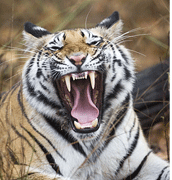
 Set amidst the Vindhyan ranges and the eastern flank of Satpura hill range Bandhavgarh National Park is one of the best places to see and enjoy wildlife in India. The Reserve is named after the highest hill Bandhavgarh (807 m.) in the centre of the Reserve. A chain of smaller hills, 32 in all, surrounds this hill, forming a number of valleys and spurs in between. This park was the former hunting preserve of the Maharaja of Rewa and at present is a famous natural hub for White Tigers. White Tigers, now a major attraction around the world's zoos, were first discovered in Rewa, not far from here. The terrain is broken, with rocky hill ranges, running roughly east west, interspersed with grassy swamps and forested valleys. The rivers Johilla and Son flowing on the eastern side, the river Umrar passing through the western fringes and the Bandhavgarh hill, visible from as far as 30 km., are some of the landmarks of the Reserve. Set amidst the Vindhyan ranges and the eastern flank of Satpura hill range Bandhavgarh National Park is one of the best places to see and enjoy wildlife in India. The Reserve is named after the highest hill Bandhavgarh (807 m.) in the centre of the Reserve. A chain of smaller hills, 32 in all, surrounds this hill, forming a number of valleys and spurs in between. This park was the former hunting preserve of the Maharaja of Rewa and at present is a famous natural hub for White Tigers. White Tigers, now a major attraction around the world's zoos, were first discovered in Rewa, not far from here. The terrain is broken, with rocky hill ranges, running roughly east west, interspersed with grassy swamps and forested valleys. The rivers Johilla and Son flowing on the eastern side, the river Umrar passing through the western fringes and the Bandhavgarh hill, visible from as far as 30 km., are some of the landmarks of the Reserve.
Much of the park is covered in Sal forest, replaced by mixed forests in the higher elevations of the hills. There are extensive strands of bamboo, which flowered in 1984-85, and grasslands. Generally the forests have less undergrowth here, thus offering better sightings of wildlife, notably mammals, including the daylight sightings of Tigers in the grassy 'maidans'. More than 25 Tigers are estimated for the park.
Bandhavgarh has a very deep-rooted importance of it's own in the history and mythology of India. Looming high over the entire park and located in the heart of it's core area, is a fort dating back to the mythological era of Rama and Hanuman from the Hindu epic Ramayana. It is said that the two monkeys who created the "setu", or bridge, between India and Lanka to enable Rama to cross over and vanquish the demon king, Rawana, were also the architects of the Bandhavgarh fort. This fort was used by Rama and Hanuman on their journey back to their kingdom from Lanka. This fort was later handed over by Rama to his brother Lakshmana who came to be known as the "Bandhavdhish", lord of the fort.
|